

Reliable Power Anywhere, Anytime
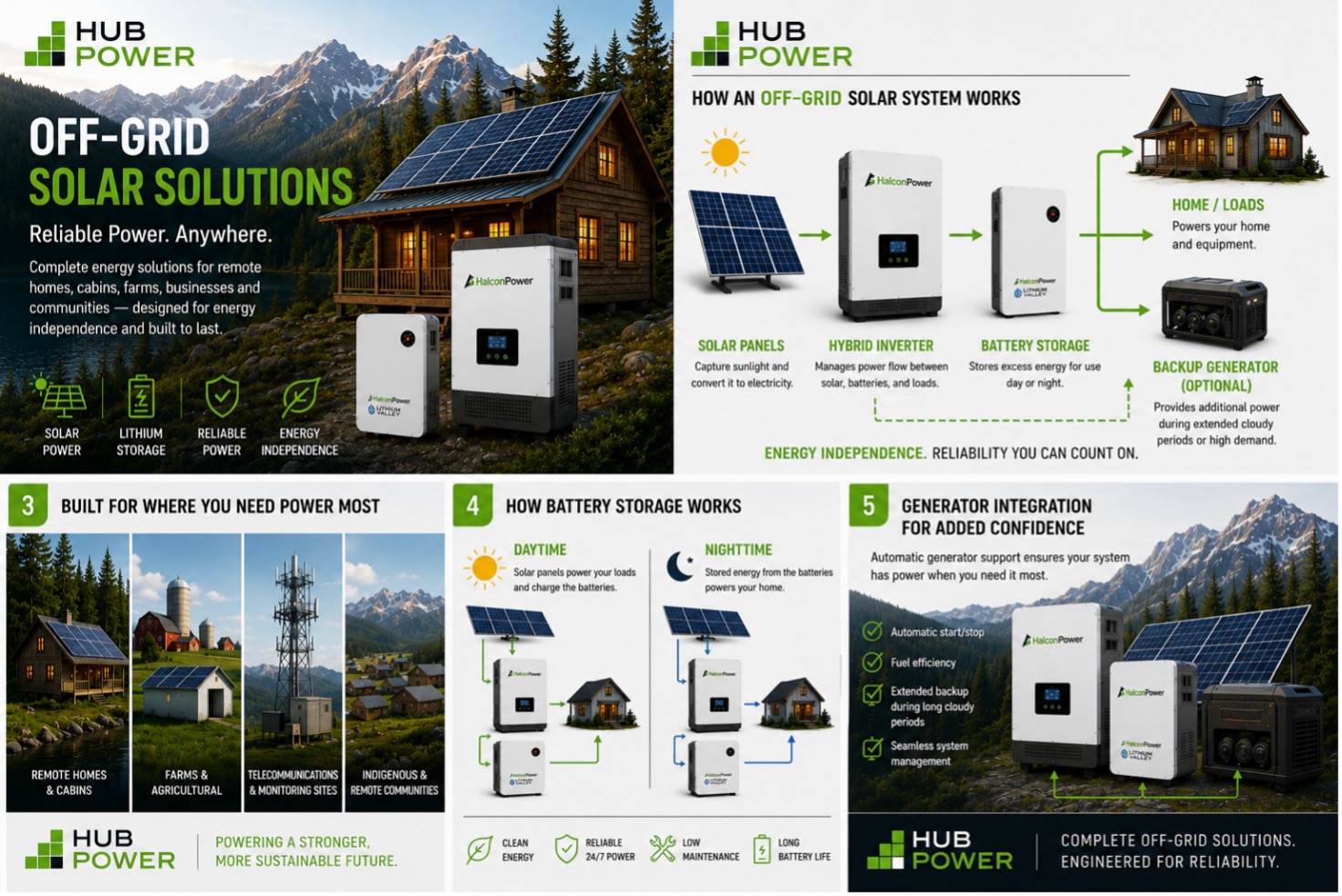
Hub Power’s off-grid solar solutions provide complete energy independence for homes, cottages, farms, remote businesses, telecommunications sites, and other locations where utility power is unavailable or unreliable. By combining solar generation, lithium battery storage, intelligent power management, and optional generator backup, our systems deliver dependable electricity day and night without relying on the utility grid.
Whether you’re building a remote cabin, powering a rural property, or reducing dependence on fossil fuels, Hub Power designs customized off-grid energy systems tailored to your specific energy requirements and lifestyle.
What Is an Off-Grid Solar System?
An off-grid solar system is a standalone energy system that operates independently from the utility grid. Unlike grid-connected solar installations, off-grid systems generate, store, and distribute their own electricity using solar panels and battery storage.
During the day, solar panels generate electricity to power your home or facility while simultaneously charging the battery bank. When solar production decreases at night or during cloudy conditions, stored energy from the batteries supplies power to your loads.
Because off-grid systems operate independently, they are designed to provide reliable power year-round without requiring a utility connection.
Who Should Use an Off-Grid Solar System?
Off-grid solar systems are ideal for:
- Remote homes and cottages
- Cabins and recreational properties
- Farms and agricultural operations
- Indigenous and remote communities
- Telecommunications and monitoring sites
- Hunting and fishing camps
- Construction trailers and temporary facilities
- Rural businesses and commercial operations
- Backup power applications where grid reliability is poor
For many remote properties, an off-grid solar system can be significantly more cost-effective than extending utility infrastructure over long distances.
What Components Are Included in an Off-Grid Solar System?
A complete off-grid solar system typically includes:
1. Solar Panels
High-efficiency solar panels capture sunlight and convert it into electricity. The size of the solar array is customized based on your energy consumption, location, and seasonal requirements.
2. Solar Panel Mounting System
Three main mounting options are possible:
- Roof Mounting
Roof-mounted solar arrays are one of the most common and cost-effective installation methods. Solar panels are secured to mounting rails that are attached directly to the roof structure using specialized mounting hardware designed for the specific roofing material and roof configuration.
Roof-mounted systems are ideal when adequate roof space is available and the roof has good southern exposure with minimal shading.
- Pole Mounting
Pole-mounted solar arrays are installed on a steel pole anchored securely into the ground. The solar panels are attached to a specialized mounting structure at the top of the pole, allowing the array to be positioned for optimal solar exposure.
Pole-mounted systems are often used when roof space is limited or when ground-level shading can be avoided by elevating the array. Many pole-mounted systems can also be adjusted seasonally to maximize energy production throughout the year.
- Ground Mounting
Ground-mounted systems use structural racking and rails installed directly into the ground using driven piles, concrete footings, or screw piles. These systems provide flexibility in array size and placement, making them ideal for larger off-grid installations.
Ground-mounted arrays can be positioned at the optimal tilt and orientation to maximize solar production while allowing easy access for maintenance and future expansion.
3. Hybrid or Off-Grid Inverter
The inverter serves as the heart of the system. It converts DC power from the solar panels and batteries into usable AC power for your home or facility while intelligently managing energy flow between all components.
4. Lithium or Lead Acid Battery Storage
Battery storage allows excess solar energy generated during the day to be stored for use during evenings, cloudy weather, and periods of high demand.
5. Charge Controllers
Charge controllers regulate the energy flowing from the solar panels to the batteries, ensuring safe and efficient charging while maximizing battery life. These charge controllers can be built into the solar inverter depending on the manufacturer and model.
6. Monitoring and Energy Management
Advanced monitoring systems provide real-time visibility into solar production, battery status, energy consumption, and system performance.
7. Backup Generator (Optional)
Many off-grid systems include an integrated backup generator for additional reliability during extended periods of poor weather or unusually high energy demand.
How does Battery Storage Work?
Battery storage is what makes off-grid living possible.
During sunny periods, solar panels generate electricity to power connected loads. Any excess energy is directed into the battery bank for storage. When solar production decreases or stops, the inverter automatically draws energy from the batteries to continue powering the home or facility.
If you use lithium batteries, they provide:
- High energy density
- Long service life
- Fast charging capability
- Minimal maintenance
- Reliable performance in varying weather conditions
- Advanced safety and monitoring features
Lithium batteries do not perform well in constant cold weather conditions where the ambient temperature will reach -20C or lower. In these instances, we recommend lead carbon batteries which can charge and discharge at low temperatures and have high cycle life compared to flooded or AGM chemistries.
Battery capacity is carefully sized based on your daily energy consumption, desired backup time duration, and seasonal solar availability.
What are the Generator Integration Options?
While many off-grid systems operate primarily on solar and battery power, generator integration provides an additional layer of reliability.
When battery levels reach a predetermined threshold or energy demand exceeds available solar production, the system can automatically start a backup generator to recharge batteries and support critical loads.
Generator integration offers:
- Extended autonomy during prolonged cloudy weather
- Reduced generator runtime compared to traditional generator-only systems
- Lower fuel consumption
- Automatic operation and remote monitoring
- Enhanced reliability for mission-critical applications
- Ability to supply power regardless of the weather conditions
Why Choose Hub Power?
Hub Power delivers turnkey off-grid energy solutions engineered for reliability, efficiency, and long-term performance. Our team designs each off-grid system based on your energy requirements, ensuring the right balance of solar production, and battery storage, and backup generation to meet your needs today and into the future.
From system design and equipment selection to installation support and ongoing support, Hub Power provides the expertise and technology required for customers to achieve true energy independence.
Ready to Go Off-Grid?
Let’s Build the Right Solar Solution
Whether you need components or a complete system design, our team is ready to help.
👉 Request a Quote, sales@hubpower.ca
👉 Talk to an Expert, 604-420-7737