
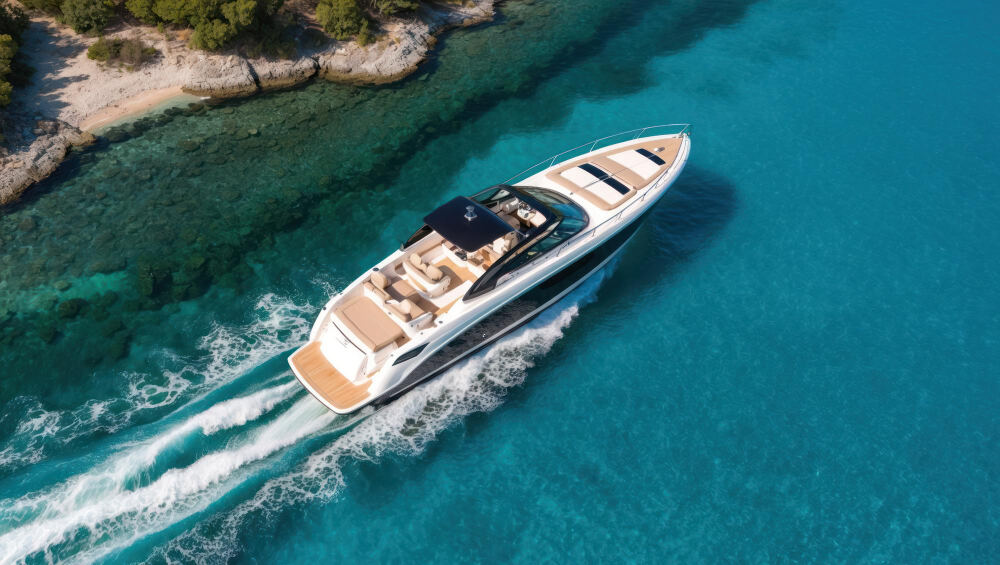
How Propulsion Type Changes Yacht Batteries in Canada for Sailboat vs. Motor Yacht
When boat owners compare power systems, they mainly focus on chemistry, lithium, AGM, and lead-carbon. However, there is a more fundamental inquiry that should come first: what is propelling the boat across the water? A sailboat and a motor yacht may have the same dock, flag, and overall length, but the demands they impose on their electrical systems are vastly different.
This differential is more important than many buyers think. The style of propulsion influences charging patterns, load profiles, weight tolerances, and even the frequency with which the engine runs, all of which have a direct impact on the best yacht batteries in Canada. Getting this match wrong results in premature failure, inconvenient power outages, and costly replacements that are well before their time.
Why Propulsion Drives Electrical Demand
The motor yacht’s engine runs for the majority of its journey. The alternator will almost always be feeding the housebank, while the battery’s main job is to smooth out demand and start the engine reliably. Sailboats, on the contrary, often spend long periods of time without the engine. The batteries of a sailboat must be able to carry the load for many hours, or even days. They are only recharged when the diesel engine is running or when the solar or wind system tops them up.
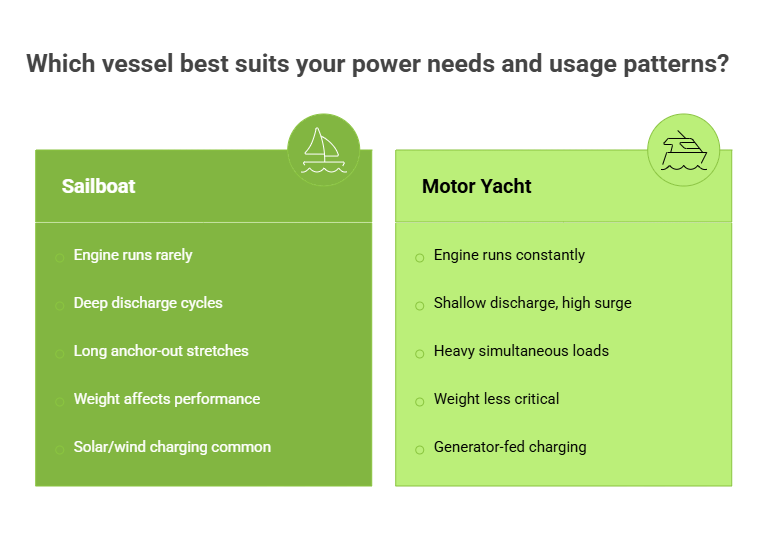
The difference in engine runtime affects nearly all downstream decisions about battery size, chemistry and configuration. The house bank is the lifeblood of sailboats. When the engine is off, all lights, instruments, refrigerators, and autopilots draw energy from the battery. Battery owners need batteries that can withstand deep cycling, maintain voltage at low amps, and recover quickly when charging windows are restricted.
LiFePO4 lithium batteries have become the preferred choice for serious cruisers for good reasons. They absorb charge quickly, give usable capacity well below 50% state of charge, and weigh nearly half as much as an equivalent lead-acid bank, a significant advantage when every pound counts in sailing performance. AGM and lead-carbon choices remain affordable for budget-conscious sailors, particularly those who daysail and frequently return to shore power.
Motor yachts reverse the equation. With generators and main engines running most of the time, the house bank rarely reaches deep discharge levels. However, it does encounter high simultaneous loads, with air conditioning, massive inverters, windlasses, bow thrusters, and multiple refrigeration units all pulling hard at the same time. Here, the emphasis changes to batteries capable of delivering large burst currents while still withstanding the vibration and heat of a busy engine room.
AGM batteries remain popular in this market because they can withstand continual float charging and cranking duty without complaint. However, many bigger motor boats in Canadian waters are transitioning to lithium house banks paired with dedicated AGM starting batteries, resulting in a divided design that places each chemistry where it works best.
Bank Separation, Sizing, and the Canadian Climate Variable
Most well-designed yachts, regardless of their propulsion system, separate the house batteries from the starting batteries. The ratio and size of the batteries differ dramatically. A sailboat may carry a 100Ah starter along with a 400 to 600Ah housebank. Motor yachts could run the opposite ratio, a large cranking capacity to power twin engines with a large house bank that can coast through the nights of anchor out when the generators go silent.
When evaluating batteries for yachts in Canada, owners should consider how their charging system handles mixed chemistries. A lithium starter bank and a house bank of AGM require careful consideration of voltage regulation, the selection of isolators, and alternator safety. Mismatched components can be a major cause of quality batteries failing early.
Canadian waterways provide their own level of intricacy. Cold starts require high cold cranking amps, and a motor yacht’s twin diesels consume more starting batteries than a single auxiliary on a 36-foot sloop. Lithium chemistry, while good under most settings, requires integrated heating or cautious charging techniques when temps fall below freezing, something to consider for shoulder-season cruising on both coasts and the Great Lakes.
The optimum battery configuration isn’t determined by brand loyalty or the latest chemistry trend. It’s about honestly examining how the boat is used, how often the engine runs, how long it remains at anchor, and what uses power when the keys are turned off.
A sailor traversing the Strait of Georgia under canvas has different concerns than a motor yacht owner passing through marinas on the Trent-Severn. Both deserve a battery bank designed around how they utilize their vessel. Working with a skilled supplier who understands the entire range of yacht batteries in Canada, from entry-level AGM to high-performance LiFePO4, can mean the difference between a system that fails after two seasons and one that lasts a decade.